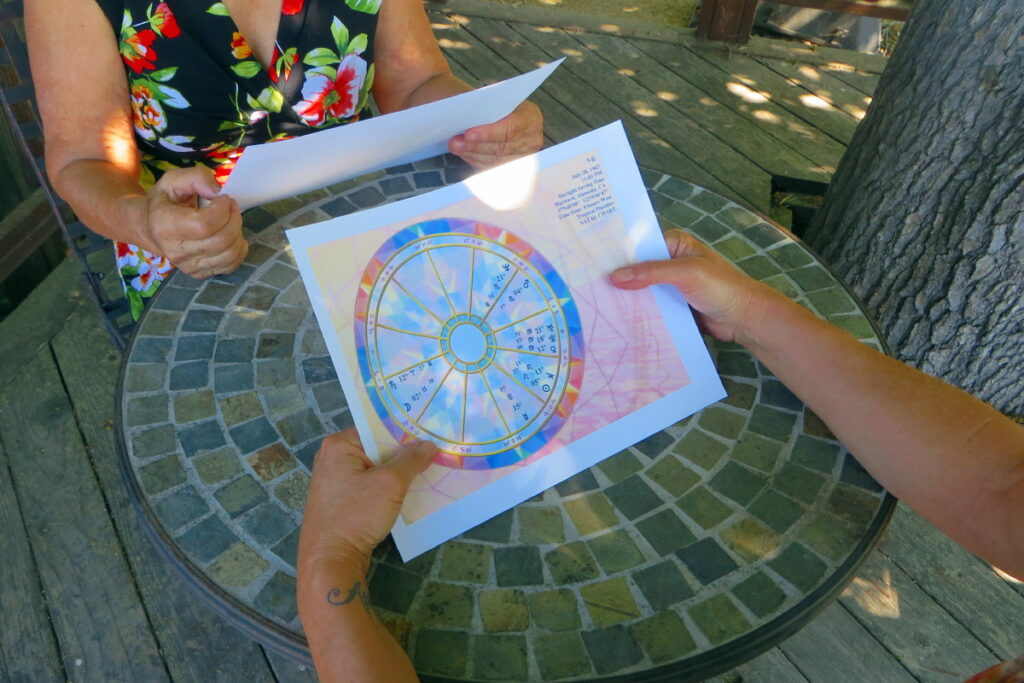
When I first glance at the transit chart, I look at the houses activated by transiting planets first , rather than signs or aspects. I look at the houses of the transits first because the houses indicate which departments of life are currently activated, rewarded, or challenged. This will give me the first clues before I build on the information with signs, aspects, and relations to the natal chart..
Learning the keywords for each house is essential for understanding what area of life is represented.
The Houses Keywords
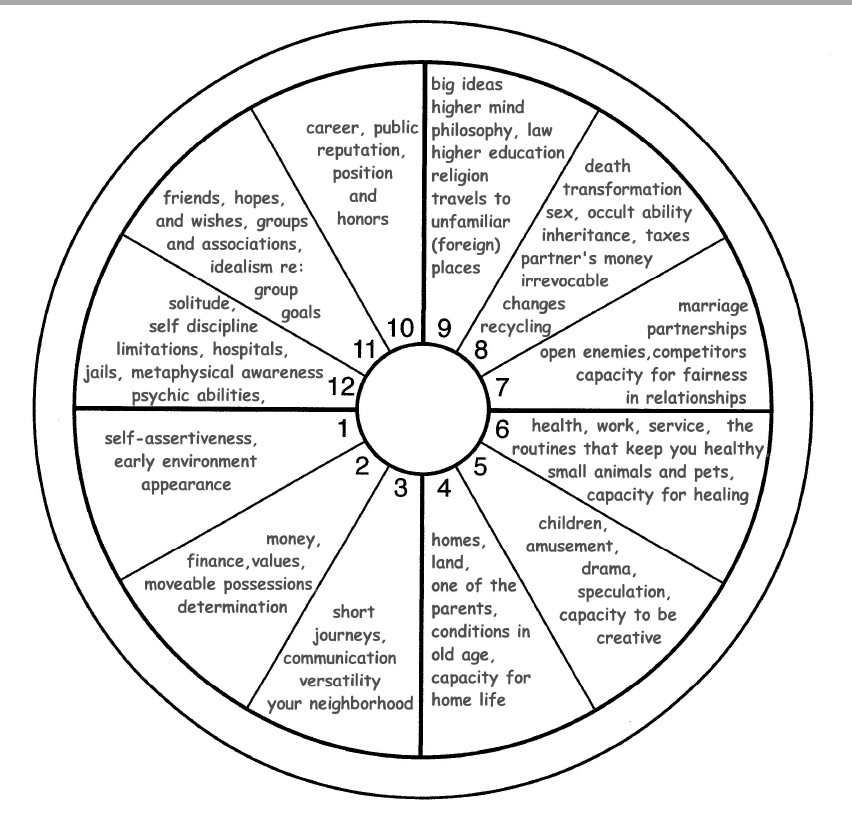
PLANETS
I look at houses activated by transiting planets while noting that each planet has its own nature, interest, and personality.
If planets were people, Venus is the sensual femme fatale, Mars is the athlete or warrior, Jupiter is a good natured world traveler or the know-all guru, who rules himself, Saturn is the wet blanket who finds the problems and mentions them when the other planets want to party.
Mercury is either reading a book or talking to everybody about everything at once while going quickly from one person to another giving them messages or telling gossipy tales. The moon is either gloriously shining with a silvery light, casting a magnetic glow over the party, or she is crying on the couch, covered with a dark blanket, her exquisitely sensitive feelings having been hurt by a rude guest. The sun is shining brightly, blinding some of the guests while fascinating others with his talent.
The heavies (outer planets) were not invited to the parties of the ancients, but since science discovered them, they insist on an invitation. When Uranus enters the room, the crystal breaks or the guests scatter in different directions for no apparent reason. Neptune comes in with a bong and drinks, promising instant enlightenment if you just take a toke. Then Pluto torches the whole place. The next day a phoenix rises from the ashes, and the world dream begins again.
What is the planet doing in that house, how does it act there?
By combining the nature of the particular planet with the part of life represented by the house, we get an idea of what is triggered in the transit. We look in the ephemeris to see the movement and how long this sojourn in a particular house will last and when it will end.
Each planet’s sojourn in a house is affected by the planet’s affinity with a house. Some planets are more comfortable in certain houses than others. Just as planets are more comfortable or can express themselves better in certain houses than others, planets have affinity for certain signs, as well. When a planet is not in a house or a sign with which it has affinity, the planet does not express its unique qualities with as much success as it would have in better placements.
ASPECTS: What is the transiting planet doing to your natal planet(s)
I also look at the relationship between the transiting planet and the natal planets in the birth chart. Are they in a significant angular relationship with one another? Are there other planets connected by an angular relationship? Where are they? That will be part of the picture too.
Learn the Keywords!
Learn the keywords for the houses, learn the keywords for planets, learn the keywords for the signs, and learn the keywords for the angles and you will be able to put together a word picture of what is happening in your own chart. Many astrological textbooks have keyword lists. A old book I own “The A to Z Horoscope Maker and Delineator” has an extensive list of words that initially enhanced my understanding of astrology when I was a beginning student. A comprehensive book on keywords is by Rex Bills “The Rulership Book” available online here.